Showing posts with label Ramadan. Show all posts

Monday, August 24, 2009

Leila

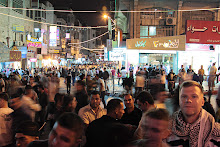
Leila is Arabic for night. Particularly during Ramadan--the lunar month of fasting from sunrise to sunset--at night the Palestinian landscape undergoes a transformation of sorts.

To clear a common misconception: this is not the desert. There are deserts to the south (the Judean Desert, the Negev, the Sinai); there are deserts to the east (the Jordan Desert and the Southern Desert); but technically, most of Israel/Palestine--particularly the coastal and highland areas--is a "Mediterranean" climate. This means hot, dry summers and cool winters, with most of the precipitation coming during the winter months. Los Angeles has a Mediterranean climate.

There's plenty of greenery mixed in with the reddish-brown dirt on the hillsides--olive trees and other herbaceous shrubs that are used to long, dry summers. The days can get hot; if you've been looking at the weather applet off to the right, you'll note that the daily high temperature is in the high-80s to mid-90s--but as "they" say, it's a dry heat: the humidity is typically low in the daytime. Ram'allah is in the hill country, about 2900 ft above sea level, less than 40 miles east of the coast. The proximity to a large body of water moderates the regional climate--that is, it stays cooler in the day (and summer) and warmer at night (and winter) around here than it would if the sea weren't so close. Also, every 1000 feet of elevation corresponds to a 2 degree (Farenheit) temperature decrease--so it's cooler up on the hilltop than down in the valley.

So that gives you a sense of the physical geography of the area. What does this mean--and what does it have to do with the night? Most of the nights I've been here, a couple hours after sunset as the temperatures drop and prevailing winds off the Mediterranean push moist air inland, a thick blanket of fog rolls east. As the moist air is forced upward by the hills, it cools and the fog thickens. The hills and valleys are breezy most days and nights, and so standing on the roof of the guest house, several nights now I've watched the fog roll in and over Ram'allah... only to push further east, towards Jericho (of course, Jericho is in the lowlands around the Dead Sea, so it's warmer there, and it's likely the fog dissipates in the warmer air on the other side of the hills). Some thin tendrils of fog linger in the valleys, though, shadowy and cool until the morning sun climbs high enough to burn the shreds away.

If you time it right, then, you can witness this cool, damp blanket being dragged eastward, and watch the lights of Ram'allah change from pinpricks of brightness to fuzzy technicolor orbs.

And last night after the fog rolled through, the crescent moon fell slowly into the sea; from the apartment building just across the street, some Ramadan revelers played Louis Armstrong's What a Wonderful World several times, loud enough for the entire neighborhood to hear and enjoy.

Looking northwest from the roof of the guest house, towards the "suburb" of At-Tireh, with the old Byzantine church, At-Tira mosque and the UNRWA (United Nations Relief Works Agency) compound making the fog glow.

Sunday, August 23, 2009

Saba'h, Shabbat, Sabbath

The three monotheisms might converge on belief in the same God, but they don't agree on which day to set aside for worship. The seventh day of the Islamic week is Friday; most businesses are closed for the day--certainly after noon--although some will open in the evening to entice weekend shoppers. The Jewish sabbath starts at sundown on Friday and runs until sunset Saturday--trying to get anywhere on a Friday night in Jerusalem is tricky, because the Israeli buses don't run again until Saturday evening, and so your best bet is to find a Palestinian taxi driver who won't gouge you too much. In Christian areas, Sunday is the day of worship. While this doesn't effect too many shops, and travel not at all, it does produce some headaches.

As a result, it's hard to get anything done in Palestine from Friday to Sunday. The NGOs (non-governmental organizations) and municipal offices I'm trying to work with basically all have 4-day work weeks. Throw Ramadan into this tangled mess of religious observance, and it gets harder to get any work done--Muslims get up before dawn to have breakfast, and then often go back to bed to sleep part of the day away, and things s l o w d o w n q u i t e a b i t . . .

So while I'm waiting for my contacts to get back to me, I've been walking around town, taking pictures of stuff. There are lots of buildings and projects with signs on them, attributing the construction, addition, or renovation to some international donor. It is in this context that USAID is marketing its projects quite heavily--as you can see below.


First off, a "typical" street view just east of the center of Ram'allah. This is looking west along An-Nahda Street. The radio station you see advertised on the billboard runs programming partially funded by USAID.

This is facing the other direction from the previous shot--looking east. In the distance, you can see another billboard advertising a USAID program.

A bit closer, you can see it's the same program from the billboard I photographed earlier, over to the northeast near where I'm living--it's advertising USAID-funded programs to train health care workers.

A bit further east, towards the wealthier part of town, this billboard advertises another program. The caption reads:
Step by step
We rebuild and develop
Empowering more than 2000 youth leaders
From the American people (United States Agency for International Development)


There are two interesting things about this particular advertisement. First, the word for "empowering" (or "empowerment") is tamkeen--which is also the name of a specific aid project that aims to inculcate Arabs to Western norms of secular, civil society--through programs like coloring books for children, radio and television programs with strong women characters, education, etc. Second, this billboard seems to indicate that "empowering young leaders" has something to do with the media. In case you were wondering, the Tamkeen project is one of the "fall-back" programs in my research (meaning, it's big and widespread and ongoing, and is a bit too big for me to take on at the moment--but if I can't get any traction on my main project, this is what I'll dig into).

Saturday, August 22, 2009

Ramadan is here

Ramadan started today. A few people in the guest house had thought it started Friday, and for much of the morning/afternoon on Friday, it felt like Ramadan--certainly, the volume and length of the broadcasts from the local mosques seemed to indicate that it was, in fact, Ramadan. Instead of the one- or two-minute call to prayer, a couple mosques put their entire Friday noon services on the loudspeaker.

I stayed around the guest house most of the day, checking e-mail and constantly looking at my cell phone, as one of my research contacts had said she'd get in touch with me yesterday. In the late afternoon, a couple of the Bir Zeit students wanted to go into town, and in particular wanted to go to the store where I got my fan on Thursday. This same store was doing a brisk pre-Ramadan business, selling multicolored strings of lights, extension cords, etc.--pretty much anything you'd need to create a festive Ramadan light display. The Bir Zeit students wanted to make their own Ramadan display up on the roof of the guest house.

So I walked with them to the center of town and took them to the store--which, by the way, was closed because it was Friday afternoon. Main Street was very quiet, and most of the stores and restaurants were closed. This was surprising--only because I was expecting all the stores and restaurants to be closed: after all, I had been told that Ramadan had started. So as we were walking along past open restaurants, I was speculating to myself about the religion of the owner, the secular-ness of Ram'allahn society, etc. It was only when we got to the closed electric appliance store that we found out that no, Ramadan hadn't started yet.

So the Lonely Planet (it's so lonely) guide book was right, and the internet was wrong (one web site said that Ramadan starts on the 22nd for North America, but a day earlier in Asia due to different moonrise times). It wasn't so surprising that there were some restaurants and shops open yesterday afternoon--it was just a Friday afternoon. Sure enough, as afternoon faded into evening, more shops and restaurants opened, and the downtown area came to life.

As we were walking back, the street filled with police cars--no sirens, but flashing blue lights. A dozen or so Palestinian police were cordoning off the street from traffic, and some very-professional looking individuals in midnight blue uniforms got out of a black SUV and started scanning the street. We ducked into a bookstore for a minute, and when we came out, three of the guys in dark blue were escorting down the street a middle-aged man with glasses and a tailored suit. He passed a few feet away from me and I got a good luck at him, but his face didn't ring a bell. There was a merchant sitting outside his shop, watching the whole display of police and political power.

I nodded my head in the direction of the VIP, and asked ma' huwa? (Who is he?)

The shopkeeper shrugged and said ma'b 'araf... rajul kabeer? (I don't know... an important man?)

rajul kabeer indeed