Showing posts with label Ram'allah. Show all posts

Thursday, April 7, 2011

There's no avoiding it


While preparing my presentation for AAG next week, I ran across a photo I took in 2009 inside the Qalandia checkpoint. I didn't have time to do a great job composing the shot--I don't know how much the IDF allows inside the checkpoints, and the time prior to this, the IDF had given me a really rough time getting through. So I snapped a few quick shots, just so I could share what it's like trying to get from Palestinian areas into Israel proper.

The Qalandia checkpoint is the main transit point between Ram'allah and Jerusalem.


Friday, September 18, 2009

Checkpoint? Checkmate.

This trip is winding down, and as Friday starts the weekend--and I leave on Sunday--there's pretty much no research I can get done from this point on. So my plan was to go to Jerusalem one last time and do some leftover tourist stuff, maybe buy a souvenir or two, and make arrangements for my departure Sunday (long story short, because cabs from this side of the border aren't allowed over the border, I have to get an Israeli-tagged cab to pick me up and take me to Jerusalem on Sunday).

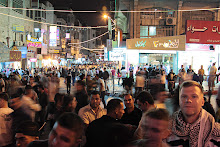
As I walked to the center of Ram'allah this morning, I noticed that the butcher was very busy--this is the last Friday of Ramadan, and Sunday marks the end of Ramadan. People will celebrate Eid with a feast.

When I got to the bus depot, I noted that there were none of the bigger buses that normally run all over the West Bank--just the little yellow minivans ("service taxis," or sherut) that aren't allowed across the border. After some asking around, I found out the Qalandia checkpoint was closed. The Israelis weren't allowing any vehicles through, and only had one gate open. Typically on Fridays the Qalandia checkpoint is mobbed--even moreso during Ramadan--as Palestinians go to the Haram ash-Sharif to pray on the Muslim sabbath. But today, apparently because it's the last Friday of Ramadan, the Israelis felt like being more difficult than usual.

I knew the checkpoint would be busy--that was part of the point for me going today: I was going to take pictures of the checkpoint and all the human cattle being funneled through the ritual humiliation. But I didn't see any point in going to the checkpoint and not being able to cross into Jerusalem and do all the things that I wanted/needed to do.

I'm going to have to re-think my plans for Sunday, as I was originally thinking of starting the journey to the airport at about 5 pm, an hour and a half before sundown and the end of Ramadan (and the beginning of Eid). It might be a long trip.

But fear not, I have pictures!

Last weekend four of us from the guest house took a road-trip through Israel, going to the Dead Sea, the Negev Desert, and then ending up in Tel Aviv. We put about 800 (~500 miles) kilometers on the rental car over three days, and had we gone for a fourth day, we would've gone up to the Galilee and ended up covering about 90% of Israel. It's not a big country.

We started out at Masada, climbing up the "snake path" up the eastern side of the hill before dawn. It's a pretty brutal climb: ~400 meters up, and quite steep. It was rough, too, because for a number of reasons I won't go into here, I only got about 2 hours of sleep the night before, in the driver's seat of our car. So I didn't take a lot of pictures during the climb, and the ones I took didn't turn out all that great. But to be honest, the whole "watch the sunrise over the Dead Sea from the top of Masada" is overrated.

So instead, feast your eyes on this gorgeous Ram'allah sunset, as seen from the top of the guest house:

Like the Herodion, Masada was built by Herod the Great. Also like the Herodion, I was underwhelmed by Masada, and I didn't take a whole lot of pictures. Here's a local bird. Interesting, in that it's been banded (twice)--look at its feet.

Here's another bird at Masada, right after sunrise.

EXTREME CLOSE-UP!!!

After hiking up Masada, we needed to cool off a bit. The Dead Sea region sits below sea level, and that makes it a lot hotter than Ram'allah, and it's more humid, too. North of Masada, there's a nature reserve centered on some springs, called Ein Gedi. Ein Gedi has waterfalls and swimming pools, and sounded like just the place to relax and recuperate from a rough night and tough pre-dawn hike/climb. We got there pretty early, and shortly after entering the park, saw some ibex on a cliff.
There were also a bunch of these rodents hanging out all over the place--mainly in the cool shadows and near where some of the irrigation hoses were leaking water onto the ground. They're about 2-3 times the size of a guinea pig, and were rather unafraid of us--as long as we didn't get too close.

We got to a waterfall-fed pool, and for some reason I didn't get a good picture of the pool. It was gorgeous, though. Cool & refreshing, and for a good hour or so, we had it all to ourselves. Well, us and the dragonflies (who, I'm guessing, were responsible for the complete lack of mosquitoes around the water).

Sadly, we had to leave Ein Gedi earlier than I would've liked, because several buses pulled up and vomited out a couple hundred tourists; our idyllic little oasis became mobbed, and the rest of the park turned into a massive human traffic-jam--and the jam included several Israelis who were carrying rifles. Not in uniform or anything, and not military-issue weapons (they were bolt-action carbines).

So we went south, into the Negev, and ended up at Makhtesh Ramon--the huge crater from a meteorite impact tens of millions of years ago. Again, this was relatively underwhelming, as it's billed as a cross between the moon and the Grand Canyon. Wadi Rum is less than a hundred miles east of here, and it's a much more spectacular site. We stayed the night in a Bedouin camp in the crater, and that was nice enough--especially with all the stars that were visible. I took this shot the next morning, from the eastern rim of the crater.

Two of us went on to Tel Aviv/Jaffa from here, and I took some photos of Jaffa and the Mediterranean, but I haven't had time to Photoshop them, yet. Rather than Jaffa pictures, then, I'll close this post with a shot from Ram'allah the other day. You can make your own joke.

Sunday, September 6, 2009

Bits and Pieces

A week ago I went to Bethlehem for the day, and I still have to post more about that trip, but I keep picking up little things here and there that I need to share. Random, unconnected stuff. So here some of it is, in no particular order:
  • The billboard near me--the one with the USAID feel-good advertisements on each side--has changed. Both sides are advertisements for a furniture store. I won't post (or take) a picture of the new signs, but it's interesting that the USAID signs are gone.
  • On a related note, I went to Birzeit University the other day, and on the drive (it's a good five miles one-way from the center of town) there and back, noticed that the European Union has a bunch of billboards advertising its humanitarian aid projects. They might need to take a lesson from the Americans, though: one EU sign shows a blond kid drinking from a water fountain, the other shows a guy with a big straw hat hoeing a field; both signs have--in English--short slogans about humanitarian aid. Earth to EU: who are you marketing your programs to?
  • The other day when I was walking through the center of Ram'allah, I heard a very loud conversation being pumped out of speakers somewhere. Though it was in Arabic and they were talking very fast, it was some sort of radio show (like whatever "morning zoo" type radio programs you hear on American radio), and the host was talking to several different people. It got louder as I made my way around the al-Manara circle that marks the center of Ram'allah, and then suddenly I was in the middle of a crowd, and right next to me is a guy with a microphone, talking to a young woman--and her voice was the one I was hearing on the speakers. It's weird to be walking through the center of a town in a foreign country, and stumble into a remote broadcast for a radio station.
  • The New York Times posted some photos taken near here on Friday. Go here and look at pictures #7 and #8. #7 is a brilliant photo, one that I wish I had taken; #8 isn't bad, but the caption is a bit wrong. Qalandia is nowhere near the Old City; yes, those are people waiting to get through the checkpoint to get to the Old City (and the Haram ash-Sharif), but it's a 10-15 minute bus ride from the checkpoint to the Old City.
  • On another audio/visual note, I can take video with my Canon DSLR, but even after converting & shrinking the files, for some reason I'm unable to get the video to upload to YouTube. Solution: I e-mailed the file to Mary and let her post it. So if you want to see/hear video of the evening call to prayer in Ram'allah, click here (it's a ~4 MB file, so if you're on dial-up, be patient while it downloads). The coolest thing about posting the video to YouTube is that there are a whole bunch of other videos of Ram'allah, shot by other people, that are all linked to mine--so you can see a lot of Ram'allah with just a few clicks.
  • Yesterday was another Strange Saturday at the guest house. I heard some loud music out in the hall, and I took a look to see who was playing their stereo/TV so loud. I saw 20+ Palestinian kids (mostly 10-14 years old, I'd guess--some of the girls were wearing headscarves, too) in the hallway, with violins, violas, cellos, etc., and a couple adults--one conducting, another playing an oud, doing some sort of concert or orchestra practice. There were a bunch of parents proudly looking on, applauding when the songs were over. It was good music, and interesting, but the crowd was blocking access to the kitchen, and I was hungry (it was also before sunset, and I didn't feel like walking all the way to one of the Christian restaurants), so I went to the Subermarket and got some stuff to snack on. When I left the building, I noticed all the cars parked in front of the guest house--many were very nice, and several had Israeli license plates. Pretty interesting that on a Saturday evening, Muslim and Christian kids from both sides of the Palestine/Israel border would converge upon a hallway at the Evangelical Technical and Vocational Training Center to play orchestra music.
  • I mentioned Christian restaurants. You can't tell just by looking at them--I guess I could ask around. Though honestly, even many Muslim owned/operated restaurants wouldn't have any problems if an obvious foreigner/non-Muslim wanted to eat before sunset--but the one I've been to actually makes a decent pizza.
  • My difficulties finding people/places continues: I went to Birzeit to talk to the former director of their Center for Development Studies, and it was a pretty frustrating experience. He told me his office was Room 110. Nope. Eventually, after not finding him anywhere on the first floor, or anywhere near the office of the department he teaches in (Economics), a woman--I think she was a maintenance-type person--helped me look. She asked me where I was from, and told me she had lived in Kansas City for a year and a half. We eventually found the right office: Room 208.
That's all for now. I had more little sniglets to post, but the rest are escaping my memory now. Tonight I'm going to walk to a hill south of the downtown area, where I've seen a lit-up ferris wheel at night. If I find it, I'm going to take some pictures.

Tuesday, September 1, 2009

Al Amari

I've fallen a bit behind on keeping this blog up-to-date. I wish I could say that's because I've been so swamped with interviews and observations, but the reality is that I've been hitting a lot of brick walls, research-wise. I've uncovered a lot of very interesting, compelling, and relevant stuff, but I'm finding it very hard to find anyone who will actually follow-through and talk to me. Americans and Palestinians alike, all seem to be avoiding me. Later, I'll post some ruminations on this aspect of my field work, but for now I think I'll just share this:

On Saturday, several of us from the guest house (there are a bunch of Birzeit University students living here, including some Americans, Europeans, and an Aussie who are studying Arabic) went to the center of town to meet up with the director of an NGO (non-governmental organization) that teaches English to Palestinian kids in the Al-Amari refugee camp. The Birzeit students are here for three months or more, and so wanted to volunteer. I was tagging along to volunteer and/or observe and/or make another contact in the NGO community; schooling in the camps is by and large left to the United Nations.

So we got to the designated meeting place, and after 15 minutes or so of waiting, we called to find out why the director hadn't met us. Well, it was Ramadan, and because this woman hadn't heard back from Birzeit that anyone would be volunteering, she had canceled everything. The Birzeit students are going to wait until after Ramadan and try again—during Ramadan, they do the English lessons in the morning, and that's when Birzeit has its classes.

But some of us (well, me and anyone who felt like following) weren't deterred. I had never been to an honest-to-goodness refugee camp, and so I decided to walk down to the camp to take a look around. To give you a very, very brief background, these are "camps" in only a very loose sense. Most of the refugee camps in Palestine go back to the 1948 War of Independence (called an nakba, "The Catastrophe," by Palestinians), when Palestinians fled the fighting in the North and West and took refuge in safer areas. The camps around Ram'allah are populated by Palestinians who lived in/near Jerusalem or Tel Aviv. The camps aren't collections of tents; for 60 years now, Palestinians have been building houses out of whatever materials they can get, and there is some very basic infrastructure (electricity, running water) that has developed over the years. Ultimately, the camps have the look of run-down, low-income areas. Some (rabid pro-Israelis) have a problem calling the residents of these areas "refugees," as the United Nations has an entire arm of the organization dedicated to providing services to the refugees (the United Nations Relief Works Agency, or UNRWA), and there is some semblance of infrastructure present. But the bottom line is that these camps aren’t recognized as legal residences, and the homes and shops are built on land that someone else owns.

I could write a lot more about the camps, but this was supposed to be a brief narrative. So I’ll get back to that.

Having walked around most of Ram’allah, relying on my geographer’s acute recall of the map back in my room, and periodically consulting my trusty keychain compass, I was able to navigate the 1.5 kilometers or so from the city center to the Al Amari camp. And, as promised, it was distinguished by two things: the generally run-down and low-income look of the area, and the UNRWA buildings. We—an American undergrad, a British Cambridge grad, two Germans, and me—walked through the camp, which was pretty quiet. The locals we passed treated us pretty much like all the other Palestinians we’ve met—a nod and a smile, a quick greeting, sometimes a curious stare—until we hit the “main street” cutting east/west through the camp. An older gentleman—probably in his 70s, wearing a kuffiyeh—greeted us, and started up a conversation with the American undergrad and the Briton. This Palestinian asked where they were from. Upon hearing “America,” the gentleman didn’t have any problem; but when the British woman told him where she was from, he got a little animated.

“This… Palestine is my land. Jews came and took from me! Britain… Balfour let them!”

He was referring to the Balfour Declaration of 1917, wherein the British “government view[ed] with favour the establishment in Palestine of a national home for the Jewish people.” The British were in charge of the Mandate of Palestine, and so this was widely seen as the opening of the gates for European Jewish immigration to the region, the fulfillment of the Zionist dream. Of course, most everyone forgets the rest of the Declaration: “it being clearly understood that nothing shall be done which may prejudice the civil and religious rights of existing non-Jewish communities in Palestine.”

It was rather ironic to me, though; the guy gave a pass to America, despite widespread Arab/Muslim resentment of unflinching U.S. support for Israel (not to mention well over a hundred billion dollars in U.S. aid), but he blamed the British for starting the whole chain of events that led to him living in a refugee camp for the past 61 years. Of course, he wasn’t blaming a 22 year-old British woman for a government policy enacted 82 years ago, and he certainly wasn’t hostile. But it just goes to show that there are deep histories and long memories in the Israel/Palestine dispute, and no simple answers.

Enough narrative! Time for pictures:

Shortly after sunset the first weekend of Ramadan, looking west-southwest from the roof of the guest house. You can just make out the Israeli city of Rehovot as a line of lights on the horizon below the center of the frame. Less than 10 miles beyond Rehovot is the Mediterranean.

Hey, remember this billboard from Ram'allah? They've got 'em in Bethlehem, too. This one is on top of an apartment building, just north of the old city.

Another one of the USAID billboards, attached to a building housing, among other things, a bank. About ~500 meters beyond this building is the old city of Bethlehem and Manger Square.

A bit further on, looking back northeast. This billboard is attached to a building that has an honest-to-goodness parking garage (first one I've seen in Palestine).


After leaving Bethlehem to the southeast, looking back towards the old city & Manger Square. This trio of billboards not only trumpets USAID success in training health care workers, but also advertises a radio station(?) and ice cream. I'm guessing on the center billboard, because it says something like "we had for two years the wide 5:00 capacity with...[something I can't figure out]." So it seems to be advertising a TV/radio station having the biggest evening audience for two years. Michael, help?

Leaving Bethlehem behind, going southwest along a highway, I hiked through the Judean Desert (more in a subsequent post). I turned off the highway to follow this road, which had this very fascinating marker denoting an area of Palestinian sovereignty. I find it fascinating that it's against Israeli law for Israelis to go somewhere that (by definition) isn't in Israel. If you ever wonder what political geography is, it's stuff like this...

...And it's also stuff like this. This is the Har Homa settlement, which houses 15-17,000 Israelis on land seized from Palestinians during the 1967 Six-Day War. I have more photos that show more detail that I'll post later, but in the far right side of the frame you can see the construction cranes that are adding onto the settlement. This is part of the "natural growth" of settlements (despite them being illegally-located on Palestinian land in the first place) that the Israeli government refuses to stop. Har Homa, and settlements like it, are the big reason for the Security Barrier, and these settlements are choking off Palestinian communities like Bethlehem. Oh, I should probably mention this photo was taken from the east end of Bethlehem, and the low ground in the frame is the famed "Shepherd's Valley," where according to the Bible, the angels proclaimed the birth of Jesus to shepherds tending their flocks. The settlement, with its multiple schools, shopping centers, and medical clinics, is considered by Israel to be part of Jerusalem.
And that refusal to stop settlement expansion in order to accommodate "natural growth" of the community? Yeah, that concept gets really sticky when you note how nationalist/religious Israelis want to out-breed Palestinians:

Monday, August 24, 2009

Leila

Leila is Arabic for night. Particularly during Ramadan--the lunar month of fasting from sunrise to sunset--at night the Palestinian landscape undergoes a transformation of sorts.

To clear a common misconception: this is not the desert. There are deserts to the south (the Judean Desert, the Negev, the Sinai); there are deserts to the east (the Jordan Desert and the Southern Desert); but technically, most of Israel/Palestine--particularly the coastal and highland areas--is a "Mediterranean" climate. This means hot, dry summers and cool winters, with most of the precipitation coming during the winter months. Los Angeles has a Mediterranean climate.

There's plenty of greenery mixed in with the reddish-brown dirt on the hillsides--olive trees and other herbaceous shrubs that are used to long, dry summers. The days can get hot; if you've been looking at the weather applet off to the right, you'll note that the daily high temperature is in the high-80s to mid-90s--but as "they" say, it's a dry heat: the humidity is typically low in the daytime. Ram'allah is in the hill country, about 2900 ft above sea level, less than 40 miles east of the coast. The proximity to a large body of water moderates the regional climate--that is, it stays cooler in the day (and summer) and warmer at night (and winter) around here than it would if the sea weren't so close. Also, every 1000 feet of elevation corresponds to a 2 degree (Farenheit) temperature decrease--so it's cooler up on the hilltop than down in the valley.

So that gives you a sense of the physical geography of the area. What does this mean--and what does it have to do with the night? Most of the nights I've been here, a couple hours after sunset as the temperatures drop and prevailing winds off the Mediterranean push moist air inland, a thick blanket of fog rolls east. As the moist air is forced upward by the hills, it cools and the fog thickens. The hills and valleys are breezy most days and nights, and so standing on the roof of the guest house, several nights now I've watched the fog roll in and over Ram'allah... only to push further east, towards Jericho (of course, Jericho is in the lowlands around the Dead Sea, so it's warmer there, and it's likely the fog dissipates in the warmer air on the other side of the hills). Some thin tendrils of fog linger in the valleys, though, shadowy and cool until the morning sun climbs high enough to burn the shreds away.

If you time it right, then, you can witness this cool, damp blanket being dragged eastward, and watch the lights of Ram'allah change from pinpricks of brightness to fuzzy technicolor orbs.

And last night after the fog rolled through, the crescent moon fell slowly into the sea; from the apartment building just across the street, some Ramadan revelers played Louis Armstrong's What a Wonderful World several times, loud enough for the entire neighborhood to hear and enjoy.

Looking northwest from the roof of the guest house, towards the "suburb" of At-Tireh, with the old Byzantine church, At-Tira mosque and the UNRWA (United Nations Relief Works Agency) compound making the fog glow.

Sunday, August 23, 2009

Saba'h, Shabbat, Sabbath

The three monotheisms might converge on belief in the same God, but they don't agree on which day to set aside for worship. The seventh day of the Islamic week is Friday; most businesses are closed for the day--certainly after noon--although some will open in the evening to entice weekend shoppers. The Jewish sabbath starts at sundown on Friday and runs until sunset Saturday--trying to get anywhere on a Friday night in Jerusalem is tricky, because the Israeli buses don't run again until Saturday evening, and so your best bet is to find a Palestinian taxi driver who won't gouge you too much. In Christian areas, Sunday is the day of worship. While this doesn't effect too many shops, and travel not at all, it does produce some headaches.

As a result, it's hard to get anything done in Palestine from Friday to Sunday. The NGOs (non-governmental organizations) and municipal offices I'm trying to work with basically all have 4-day work weeks. Throw Ramadan into this tangled mess of religious observance, and it gets harder to get any work done--Muslims get up before dawn to have breakfast, and then often go back to bed to sleep part of the day away, and things s l o w d o w n q u i t e a b i t . . .

So while I'm waiting for my contacts to get back to me, I've been walking around town, taking pictures of stuff. There are lots of buildings and projects with signs on them, attributing the construction, addition, or renovation to some international donor. It is in this context that USAID is marketing its projects quite heavily--as you can see below.


First off, a "typical" street view just east of the center of Ram'allah. This is looking west along An-Nahda Street. The radio station you see advertised on the billboard runs programming partially funded by USAID.

This is facing the other direction from the previous shot--looking east. In the distance, you can see another billboard advertising a USAID program.

A bit closer, you can see it's the same program from the billboard I photographed earlier, over to the northeast near where I'm living--it's advertising USAID-funded programs to train health care workers.

A bit further east, towards the wealthier part of town, this billboard advertises another program. The caption reads:
Step by step
We rebuild and develop
Empowering more than 2000 youth leaders
From the American people (United States Agency for International Development)


There are two interesting things about this particular advertisement. First, the word for "empowering" (or "empowerment") is tamkeen--which is also the name of a specific aid project that aims to inculcate Arabs to Western norms of secular, civil society--through programs like coloring books for children, radio and television programs with strong women characters, education, etc. Second, this billboard seems to indicate that "empowering young leaders" has something to do with the media. In case you were wondering, the Tamkeen project is one of the "fall-back" programs in my research (meaning, it's big and widespread and ongoing, and is a bit too big for me to take on at the moment--but if I can't get any traction on my main project, this is what I'll dig into).

Saturday, August 22, 2009

Ramadan is here

Ramadan started today. A few people in the guest house had thought it started Friday, and for much of the morning/afternoon on Friday, it felt like Ramadan--certainly, the volume and length of the broadcasts from the local mosques seemed to indicate that it was, in fact, Ramadan. Instead of the one- or two-minute call to prayer, a couple mosques put their entire Friday noon services on the loudspeaker.

I stayed around the guest house most of the day, checking e-mail and constantly looking at my cell phone, as one of my research contacts had said she'd get in touch with me yesterday. In the late afternoon, a couple of the Bir Zeit students wanted to go into town, and in particular wanted to go to the store where I got my fan on Thursday. This same store was doing a brisk pre-Ramadan business, selling multicolored strings of lights, extension cords, etc.--pretty much anything you'd need to create a festive Ramadan light display. The Bir Zeit students wanted to make their own Ramadan display up on the roof of the guest house.

So I walked with them to the center of town and took them to the store--which, by the way, was closed because it was Friday afternoon. Main Street was very quiet, and most of the stores and restaurants were closed. This was surprising--only because I was expecting all the stores and restaurants to be closed: after all, I had been told that Ramadan had started. So as we were walking along past open restaurants, I was speculating to myself about the religion of the owner, the secular-ness of Ram'allahn society, etc. It was only when we got to the closed electric appliance store that we found out that no, Ramadan hadn't started yet.

So the Lonely Planet (it's so lonely) guide book was right, and the internet was wrong (one web site said that Ramadan starts on the 22nd for North America, but a day earlier in Asia due to different moonrise times). It wasn't so surprising that there were some restaurants and shops open yesterday afternoon--it was just a Friday afternoon. Sure enough, as afternoon faded into evening, more shops and restaurants opened, and the downtown area came to life.

As we were walking back, the street filled with police cars--no sirens, but flashing blue lights. A dozen or so Palestinian police were cordoning off the street from traffic, and some very-professional looking individuals in midnight blue uniforms got out of a black SUV and started scanning the street. We ducked into a bookstore for a minute, and when we came out, three of the guys in dark blue were escorting down the street a middle-aged man with glasses and a tailored suit. He passed a few feet away from me and I got a good luck at him, but his face didn't ring a bell. There was a merchant sitting outside his shop, watching the whole display of police and political power.

I nodded my head in the direction of the VIP, and asked ma' huwa? (Who is he?)

The shopkeeper shrugged and said ma'b 'araf... rajul kabeer? (I don't know... an important man?)

rajul kabeer indeed

Wednesday, August 19, 2009

Zombie attack imminent!

So I get up, am eating breakfast and drinking my morning tea while watching BBC Middle East, and there's a scroll across the bottom of the screen about how if zombies existed, scientists say they'd destroy civilization unless there was a rapid and aggressive response. I figure that it's a joke, or someone accidentally cut & pasted something, but so I could cover my bases when blogging about it, I go to the BBC online to double-check... and yep, there it is.

I'm doing my research on the wrong subject, apparently.

Ironically, modeling the spread of infectious diseases is a sub-field of geography called (appropriately enough) medical geography. It's an important area of study, very generously-funded (in other words, geographers can make a lot of money doing work in this field), and now I'm questioning my own research goals.

I could be researching zombies.

OK, to apply all this to Ram'allah, near the construction zone on Main St., there are several little kids who sell passersby packs of gum--think the smallest packs of Wrigley's Spearmint, but the trademark-violating Palestinian equivalent--for 2 shekels. Well, my second day in Ram'allah, I met two of these kids, and one of them is named Yusuf--which is the Arabic equivalent of my name (and, if you don't know the story behind the URL for this blog, iss-mee is Arabic "my name is"). Yusuf and his buddy gave me the hard-sell, but I didn't buy. I put them off with a strategic use of bukra--saying I'd buy a pack tomorrow.

Well, the next day I walked through the same area and Yusuf and his buddies found me again, and when I initially refused to buy, Yusuf protested that I had promised yesterday that I'd buy today.

So what does any of this have to do with zombies or medical geography? Well, Yusuf's friend Mu'awi asked where I was from, and when I said America, he asked me if I had...something. I didn't recognize the word, so I asked him to repeat it a couple times: it sounded like infalu'enseh. I still didn't get it until he put his hands over his face and pretended to cough. Influenza. Yeah, the H1N1 panic is worldwide, and associated with the U.S. Interesting, because in America we tend to think of pandemic disease as originating from elsewhere and intruding on our borders.

That's all I have for now. I hit a dead-end with the one NGO I was counting on for access to some project sites, and my options are narrowing--I'm waiting for replies to some e-mails I've sent, and depending on those results, I have to do some cold-calling of contacts people gave me.

I can't imagine what all this would be like without the internet and cell phones. Maybe it would be a lot more like what I'd prefer: I could just go somewhere and talk to people there, rather than having to go through multiple levels of bureaucratic barriers and electronic communication.

Tuesday, August 18, 2009

Useful phrases

'induka khareeTeh ram'allah? Do you have a map of Ram'allah?

sishtarayu mobile phone; wayn dukan mobile? I will be buying a mobile phone--where is the mobile store?

la, uhibb batla ma'ee kabeer. No, I would like the big bottle of water.

mahaaratuka al-lughat ul-inklizieh akbar min mahaaratee al-lughat ul-arabieh. Your English is better than my Arabic.


I remembered that I'm a geographer, and we use maps--so I found a bookstore and bought a map of Ram'allah. Unfortunately, the road I'm looking for isn't on the map.

I broke down and bought a cell phone for use over here. It was more than I wanted (my grant) to spend, but I have to face reality that phone calls get more responses than e-mails.

After not being able to find the NGO office I'm looking for, I stopped at maTa'm meester beetsa (Mr. Pizza's Restaurant) for... well, even though the pizza looked good, it was way too much food for me to eat in one sitting, and I didn't want to carry a pizza box 2 miles back to the guest house, so I got a hamburger instead. It wasn't all that bad, and the guy working the counter came out and started talking with me in English--turns out he lived in Florida and Chicago. As he was talking to me, a friend of his walked up, his hands filthy with dirt and grease, and he started complaining (in English) about having a flat tire. Not only did I get lunch, but the (restaurant) guy gave me his business card and offered to help me with my work.

Some photos of Ram'allah:

This is a ~120-degree panorama from the roof of the guesthouse, looking west-southwest right after sunset. I stitched four photos together to get the panorama, and messed up one of the joins (laptop monitor is too small to see one issue until it was too late). The center of Ram'allah is off to the east-southeast, so almost directly left from this view.


This billboard is about 100 yards from the guest house. This side says:
Step by step
We rebuild and we develop
Training 12,000 health service providers
From the American people (United States Agency for International Development)


This side says:
Step by step
We rebuild and we develop
Build and repair more than 6100 classrooms
From the American people (United States Agency for International Development)


There's another one of these billboards over on the other side of town, over by a school with USAID logos all over it--the school has an astroturf soccer field, too.


Monday, August 17, 2009

Ram'allah: under construction

Walking around Ram'allah has been interesting from a number of perspectives. First, to give you a brief narrative snapshot of Ram'allah, it's a city of about 60,000 people roughly 20 kilometers north of Jerusalem, and is the de facto center of Palestinian politics and international aid efforts. The Palestinian National Authority is headquartered here, and Yassir Arafat lived here when he was President of the PA. All that said, it's still a pretty small town, and in many ways is a bit of an idiosyncratic provincial backwater--30% of the population is Christian, although the city has a long history, that history is basically based on Ram'allah being a stop on the way from Jerusalem to other places (Nablus, Jenin, Damascus, etc.) that are bigger and/or more famous.

All that said, it's an interesting place. It's very hilly, and so walking just about any distance means going up/downhill as much as 150 meters. The hills that aren't full of big, expensive houses or spiffy apartment buildings are terraced olive-tree groves, and in the morning a chilly fog rolls up out of the valleys and is burned off by 8am or so. All in all, it's a pretty peaceful place.

Except that everyone is busy, and one word exemplifies the place: construction. I got a little lost my first day walking around, because the street that I should've been walking on was so torn up (they're re-trenching sewer lines) I thought it wasn't even a street. There are high-rise office & apartment buildings being built, and though there is plenty of the type of trash you expect to see accumulating around a developing-world countryside, there is a lot of construction rubble, too (i.e., cinder blocks, chunks of re-bar, tile, etc.). Right now I hear a little yap-dog down the street barking its little yap-dog head off (this is a Christian area), and then in the distance I hear bulldozers, dump trucks, and jackhammers. Last night, after sunset, I heard someone using a masonry saw down the street.

The people of Ram'allah strike a stark contrast to those people in other places I've been to; here, everyone is either shopping (in the center of town), making something, or going somewhere. In Damascus, there were lots of people just hanging out--as if they were waiting for something to do. In Jerusalem, it was similar, except the waiting was "waiting for tourists." In Istanbul, people were scheming and scamming and going places--but everything had already been built. Amman was full of people who seemed to have nothing to do, too. I could go on, but instead of belaboring the point, I'll just sum up by saying: Ram'allah is moving, and its people are industrious.

A couple other observations about the place: one, you can't go very far without passing a Palestinian government office, a UN compound, or some international aid organization project--Ram'allah is certainly the nexus of Palestinian development. Two, security is pretty tight. At major intersections, and every couple hundred yards near the center of town, is a soldier in camouflage and beret, holding an AK-47 at the ready. The soldiers are friendly, though. When I was out this morning, a few struck up a conversation with me, and seemed most impressed that the population of Chicago was about the size of the population of all of the West Bank.

More later, but for now I'll share a few leftover pictures from the other side of the wall:

P.S. my internet connection here at the guest house is woefully slow, so I'm using a different format for the pictures that results in a smaller file--at the cost of lower image quality. If you like any of the pictures and want better reproductions, let me know and when I get back I can get you full-resolution copies.


One last photo of the Dome of the Rock, at night.


Early morning in the Garden of Gethsemane. This is one of the 2000+ year-old olive trees.

Lots of flowers & flowering vines in the Garden. Took a quick shot of these viney flowers, and spiffed up the shot using the Viveza plug-in for Photoshop.

16 NIS ($5) gets you a ticket to walk all around the Old City of Jerusalem on top of the city walls. This was the view on the South Ramparts walk near sunset; south of the Old City is the Franciscan Monastery, and at sunset it made a very pretty sight. This is a 3-photo HDR composite of the scene.

A little further along the South Ramparts, there's an unobstructed view of the terrain to the south. Bethlehem (Bayt Laham) is just a few miles south of Jerusalem--that's it on the hilltop in the background of this shot.

Here's a zoom/crop of that prior photo, focused tightly on the hilltop & Bethlehem. You can see the security barrier (aka "Apartheid Wall") snaking over the landscape. The Israelis built the wall in this area because of the continued building & expansion of Israeli settlements on Palestinian land in the West Bank.

The South Ramparts wall-walk ends right next to the Western Wall plaza, and so I cut through there on my way back to the Mount of Olives. As I've mentioned previously, when Israel captured the Old City in the Six Days' War in 1967, there were apartment buildings standing here. The Palestinian residents of those homes were evicted and the buildings bulldozed to make the plaza. On this evening, there was some sort of IDF induction ceremony being held, with a bunch of new recruits standing at attention.

The officer in charge--the woman near the center of the frame--was pacing back and forth, giving some sort of lecture in Hebrew. The guy to the left of center was translating into English for the non-Hebrew speakers in the crowd. It was some rambling speech about how much of an honor it was to hold the ceremony here, and how important this place was to Israelis. It made me wonder what Palestinian Muslims--whose homes had been bulldozed on this very spot, just 50 yards or so from the Haram ash-Sharif and one of the holiest places in Islam--might think about the military ceremony being held there.

Saturday, August 15, 2009

If this is Saturday, this must be Ram'allah

Made it. Taxi driver on the Ram'allah side of the checkpoint hadn't a clue of where to go, despite my map and having a phone number for this place (his phone couldn't make the connection).

So I once again experienced the hospitality element of Arab/Muslim culture. The taxi driver stopped a dozen times, asking random passersby for help/directions, and people went out of their way to help. Not just because ooh, look! an American! but because a person needed help--and even taxi drivers are considered people. At one point, the driver stops a guy walking along the street, and he can't help, but he knows of someone maybe who can, and this first guy didn't leave until the next person was able to help--until some stranger from another country got the right directions for where he wanted to go.

At one point, the driver asked a group of three guys if they knew the directions, and they conferred among themselves for a minute, and then replied along the lines of, "Sorry, we don't know this area very well, as we're from Lebanon. But if you go up the street to that grocery store, maybe they know."

Maybe I'm belaboring the point, but I just don't see this type of thing happening in the U.S.

By the way, the taxi driver turned out to be a money-grubbing jerk (note: if you ever ask a taxi driver how much the ride cost, and he simply says "you pay me what you think is fair," that's code for "I want to gouge you, but make you feel like you deserve it"), but the accomodations here at the guest house are very nice.

Enough of that; it's lunch time and I need felafel.

Friday, August 14, 2009

Hot Dog and a Pepsi

So, I'm leaving Jerusalem and going to Ram'allah tomorrow, so I can stop playing tourist and start playing researcher. Ram'allah is about 12-15 miles north of Jerusalem, but the bigger issue is the Qalandia checkpoint: following the 2000 Al Aqsa intifadeh--a Palestinian protest/insurrection movement spurred by Ariel Sharon's assertion of Israeli rule over the Temple Mount--and subsequent suicide bombings in Israel, the Israeli government decided to seal off the Palestinian population in the West Bank by building a wall/fence around it. There's a lot more to it than that, but I'm going to leave it at that for the moment because my point is trying to get through this barrier--which, depending on where you are, is fence, 24-ft tall concrete wall, and/or border crossings with tighter security than you find at the airport--is a pain. Not so much for me, but for whomever is transporting me.

I've arranged for one cab to drop me off at the Qalandia checkpoint, then I walk across, and will pick up another cab (hopefully) to take me the rest of the way to Ram'allah--or, specifically, to the Episcopal Technological and Vocational Training Center guest house, where I'll be staying for the next five weeks.

How does this have anything to do with the title of this post? Well, after talking with Mary, I decided to go on a quick shopping trip in the "New City" area of Jerusalem--the part of town on the exact opposite side of the Old City from where the Mount of Olives (and my hotel) is located. And rather than tromp through the Old City crowds and congested, convoluted streets, I walked around the Old City, to an outdoor shopping mall I had seen a few days back. That trip was a total bust; the only places open on a Friday afternoon (post-noon is the Muslim sabbath, while sunset on Friday marks the beginning of the Jewish sabbath) were restaurants and one art gallery. So I turned around and headed back, only to find a hot dog stand. The guy running it had what I like to call a "desperation ponytail," so naturally I assumed he was an immigrant from America. He wasn't, and so he didn't understand (nor had the ingredients to make) a "Chicago style" hot dog. But that didn't matter much--it's not every day that you get to have a hot dog in Jerusalem on the sabbath, and so I very much enjoyed my hot dog & pepsi.

Today: hot dogs in Jerusalem. Tomorrow: felafel in Ram'allah.

Inshallah